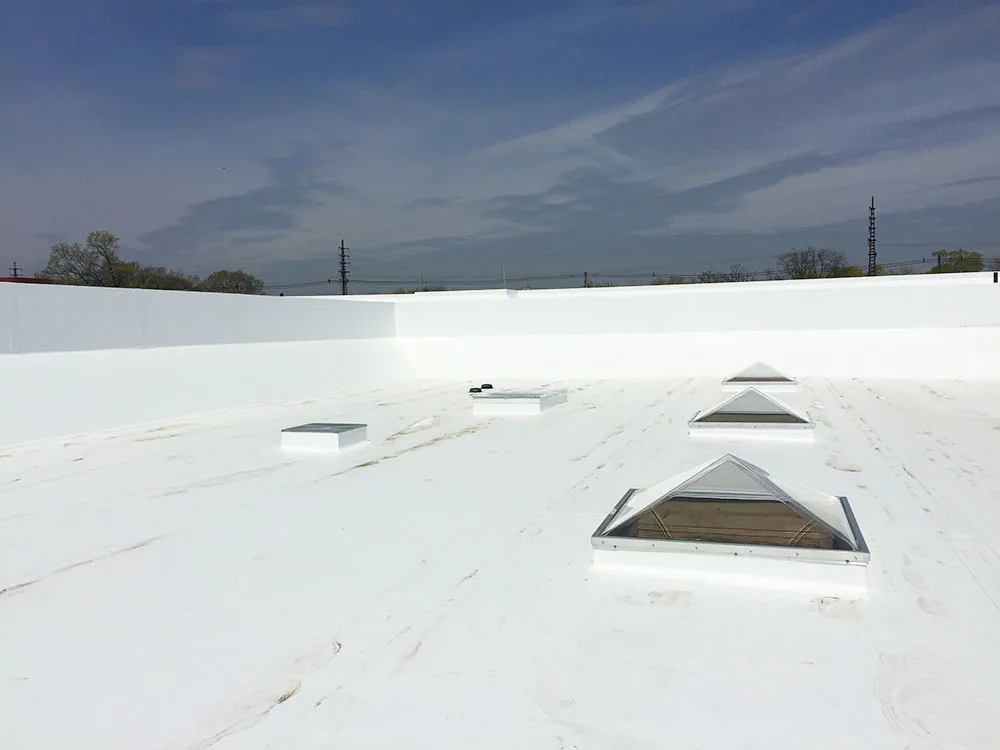
Home / Roof Systems / TPO Commercial Roofing
Send roof plans, repair history, access rules, and interior leak locations. We will inspect the TPO field, welds, attachment, and drainage, then define a repair or replacement scope from the evidence.
TPO can show punctures, abrasion, wrinkles, open laps, surface wear, and repairs that have lifted. We note where each condition sits relative to seams, walk paths, equipment, and drains. A blister or wrinkle may involve trapped air, moisture, or movement in the substrate. We do not cut every raised area; first we check its shape, bond, and relationship to the deck and other details. If moisture would change the repair choice, a targeted test cut can confirm the layers below.
Interior water marks help locate a route but rarely identify the exact entry point. Water can track beneath a membrane or along a board joint before it reaches the ceiling. We compare the interior location with roof slopes, seams, curbs, and penetrations. A marked plan and contextual photos make the finding useful for the person approving repair. They also keep a small puncture from being confused with a broader attachment or insulation problem.
TPO seams are joined with hot air. The bond depends on clean material, suitable temperature and speed, and consistent pressure. A lap can look closed while a weak stretch remains underneath. We inspect and probe representative seams, especially around corners, patches, terminations, and changes in plane. If separation appears, we define whether it is isolated or repeated across the field before recommending a repair or replacement scope.
Thermal movement and winter conditions can expose a weak transition. Nearby Detroit January normals average a high near freezing and a low in the teens, while July averages reach the low 80s for daily highs. Those numbers describe the nearby station, not this roof. We look for actual splits, shrinkage, displaced metal, or water entry. An assembly with stable seams and isolated damage may need local work; widespread bond failure changes the decision.
A TPO roof may be mechanically attached, adhered, or ballasted. The repair method must match the system and reach sound material. We identify fastening rows, plate locations, adhesive bond, cover board, insulation, and deck where visible or documented. Loose attachment can let the sheet move and stress seams. A patch placed over a moving boundary may reopen, so we verify what is holding the membrane before closing the defect.
At a curb, parapet, or drain, the field sheet meets a separate flashing detail. We inspect the membrane turn, welds, counterflashing, and substrate condition. If a curb or pipe moves, the roofing detail needs a stable interface before it can be rebuilt. Where a second layer is being considered, we compare TPO condition with PVC or EPDM only after confirming compatibility, drainage height, and moisture condition.
Water should reach a drain, scupper, or gutter without collecting behind a curb or at a membrane lap. We check outlet bowls, clamping rings, overflow openings, edge restraint, and the low point surrounding the affected area. A reflective sheet cannot correct a settled deck or blocked outlet. If water remains after a drain is clear, the slope and insulation may need review. We can coordinate a drainage correction or perimeter repair when those details are part of the same water route.
Sterling Heights has a named Mound industrial corridor and a Golden Corridor with commercial uses. Those district facts do not establish a roof type at an address. For a building with multiple roof sections, we mark outlets and edge details by area and tie each finding to its own TPO assembly. That record helps maintenance staff revisit a repaired seam or drain without treating the entire property as one uniform roof.
We cut back loose material only far enough to reach a sound, clean boundary. The repair area is prepared and welded with compatible TPO flashing, then checked for bond and continuity. A patch needs adequate overlap and rounded corners where specified by the system detail. If insulation is wet, the affected material must be removed and the roof rebuilt before the membrane closes over it. The scope identifies that layer rather than describing every problem as a surface leak.
Weather and surface temperature affect welding and adhesive work. We plan close-in so the open area can be protected if conditions change. At completion, we record the repair location, adjacent seams, curb or drain interfaces, and any limits that remain. When a roof needs broader restoration, coating restoration is considered only when substrate and compatibility support it; it is not a substitute for a failed assembly.
A useful TPO report identifies the membrane condition, attachment, test locations, moisture findings, repair limits, and the next inspection need. It separates a welded seam repair from drainage or deck work. If the roof has many sections, condition reporting can keep photographs and repair dates tied to the right area. The decision can then compare local repair, recover, or replacement with the actual findings rather than surface color alone.
Send roof plans, prior repair records, interior leak locations, and access instructions. We will inspect the sheet, probe suspect seams, and trace water to the outlet. If a test cut would change the scope, we will identify where and why before opening the assembly. The resulting repair plan will show what is confirmed, what is concealed, and how the finished detail will be checked.
It can find a section of lap that has not bonded fully. We probe suspect locations and compare them with the surrounding weld before setting the repair boundary.
Yes, when the membrane around it is sound, dry, and compatible with the repair material. We check the substrate and attachment before closing the cut.
No. Color does not remove seam, drainage, or movement concerns. We inspect actual details and plan access around current snow and ice conditions.
The extent of seam failure, wet insulation, attachment condition, and deck findings set that comparison. We document each factor and define the work boundary.
Share the original system information if available, roof plans, repair history, and leak locations. Those records help us match the field assembly and avoid opening areas without a defined question.
Send roof plans, repair history, access rules, and interior leak locations. We will inspect the TPO field, welds, attachment, and drainage, then define a repair or replacement scope from the evidence.