Home / Commercial Roofing Services / Commercial Roof Edge Metal and Coping
Send photographs, access instructions, roof details, and any interior leak location. We will check the cap, cleats, membrane turn, gutter support, and discharge route, then define the repair scope.
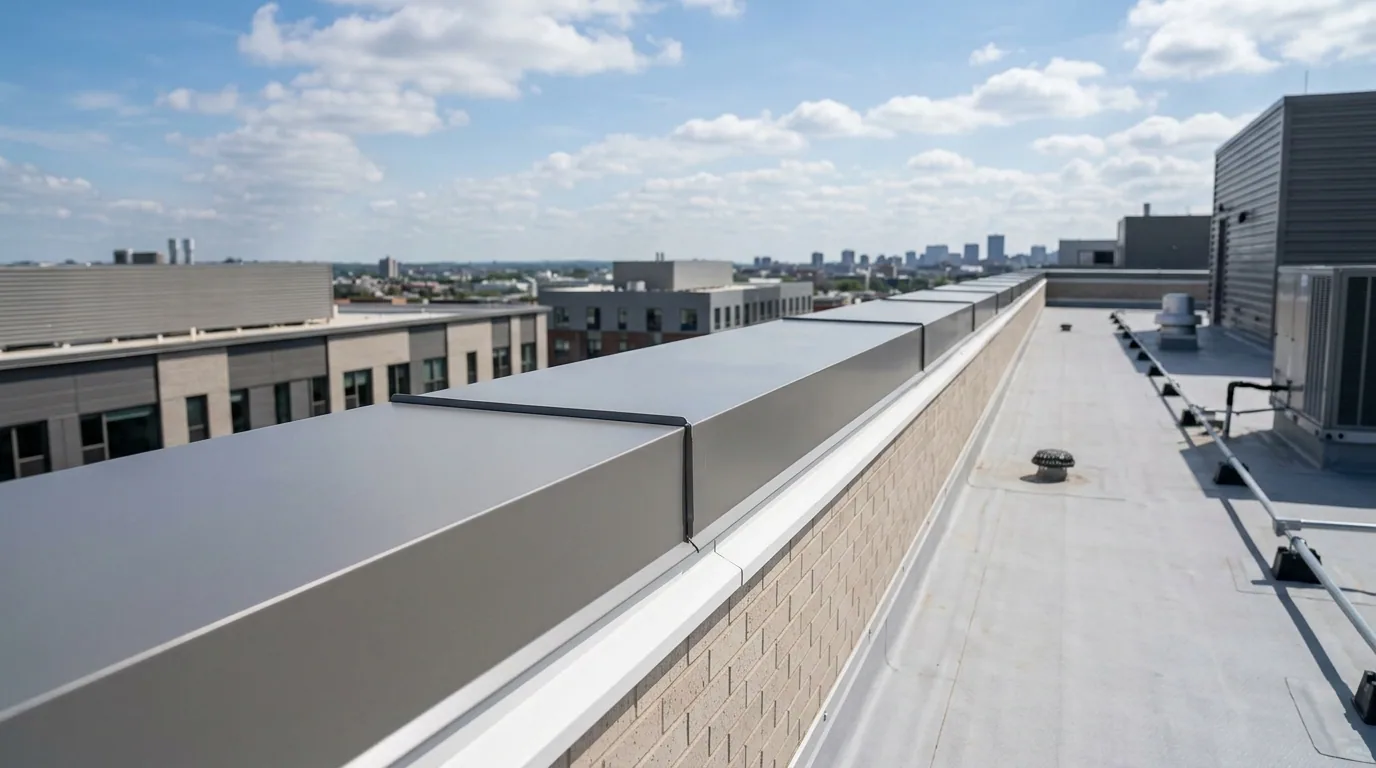
The first check is physical. We look for a cap that shifts, an exposed fastener, a separated splice, a lifted cleat, a split sealant line, or water staining on the wall below. Each condition points to a different repair. A cap can remain straight while the cleat underneath has pulled away. A bead of sealant can hide an open joint without restoring the metal connection. We photograph the top, face, and inside termination where access allows, and mark the locations on a roof plan or simple sketch.
At a gutter, we check the hangers, seams, outlet, end caps, downspout connection, and the pitch toward discharge. Debris can block flow, while a loose hanger can reverse the slope and leave water in the trough. If water is overflowing at one point, we trace the route upstream rather than assume that the nearest seam is the only defect. We note where the downspout sends water and whether an elbow, extension, or connection has separated. Roof drainage and ground drainage may meet at the same location, but they are separate parts of the repair scope.
Metal changes dimension as its temperature changes. A coping system needs joints and attachment that allow that movement while holding the cap against wind pressure. If a run is locked too tightly, a joint may buckle or pull apart. If cleats are spaced or fastened poorly, the edge can lift and expose the membrane termination. Nearby Detroit climate normals show a substantial seasonal temperature range, from January averages near 32 degrees high and 19 low to July averages in the low 80s high. Those regional normals are context; we inspect the metal and its actual attachment at the building.
Water entry can begin at the top of the parapet, the outside face, or the roof-side termination. A coping joint may admit water behind the cap, while a weak membrane turn may let it reach the deck. We check the direction of laps, the fit at corners, the condition of splice plates, and the transition to wall flashing. Sealant has a limited role. It may close a compatible joint, but it does not replace missing cleats, restore a torn membrane, or correct a cap that has lost mechanical restraint.
Edge metal is not one interchangeable strip. The repair depends on the parapet construction, existing cleat arrangement, membrane type, deck edge, and the exposure of the roof. We identify the existing configuration before ordering or forming new metal. At a low-slope roof, membrane may turn up the wall beneath a termination bar or extend into a coping assembly. At a metal roof edge, panels, clips, gutters, and fascia details can share movement and load. We do not cover an unknown attachment with a new cap and call the assembly corrected.
Fastener placement matters. A fastener set through the wrong face can create an entry point or restrict movement. A cleat that lacks a firm substrate cannot hold the edge under uplift. When the edge is opened, we check for wet material, deteriorated wood nailer, corrosion, and separation between the wall and roof layers. Any repair to the substrate should be visible in the scope. If there is evidence the deck or parapet needs structural review, we identify that before rebuilding the perimeter.
At each corner, we look for a gap where two coping runs meet, a cap that has shifted, or a termination that leaves the membrane exposed. End dams and splice details should direct water back to the roof or away from the wall. A corner patch that only covers the visible split may trap water underneath. We check adjacent roof surfaces, nearby drains, and any cricket or slope change that sends water toward the parapet. Where a roof outlet or scupper is close to the edge, the detail must be reviewed with the drainage path so repairs do not obstruct discharge.
The North Van Dyke River District and Sterling Heights Golden Corridor are named commercial areas. The Sterling Heights Mound Industrial Corridor contains a concentration of industrial and high-tech space. At the project address, inspect wall material, attachment, and termination before selecting the edge repair. They do point to a mix of buildings where a maintenance record can be valuable across multiple roof areas. We identify the specific edge condition, map its location, and connect it to the observed water path, not to assumptions based on the business address.
We remove loose or failed material far enough to inspect the attachment and substrate. The repair may include replacing a cleat, resetting fasteners, installing compatible splice plates, rebuilding a corner, or replacing a deteriorated cap section. If membrane has been cut or pulled from its termination, we repair that layer as well. New metal should engage the support and join adjacent sections without blocking the movement the system requires. A sealant bead alone is not a substitute for this connection.
Perimeter work can require a lift, fall-protection setup, roof access, or coordination with occupied space below. Before work starts, we confirm where materials can be staged and which entrances, loading areas, or walkways must remain clear. Facilities in the automotive and defense economy may have controlled access or active equipment routes; the work plan follows the individual site’s rules. We do not infer access procedures from the industry alone.
We can include coping and gutters in a roof condition report or track repeated edge findings within a roof asset management plan. The report can note repair dates, open joints, loose sections, and the next recommended review. Where the broader membrane is failing, we may also evaluate a standing-seam metal assembly or another system only after confirming it fits the building and its requirements. The appropriate decision remains specific to the roof.
Sealant can close a compatible joint, but movement usually calls for checking the cleat, fasteners, and substrate. We identify the restraint failure before choosing a repair.
The trough may be out of slope, a hanger may have dropped, or the outlet throat may be restricted. We follow flow from the high point to the discharge before replacing metal.
Only when the condition and attachment justify that scope. We map loose sections, open joints, and substrate concerns so a localized repair can be compared with continuous replacement.
Yes. Water can enter at a coping joint or membrane termination, travel behind the wall finish, and appear away from the opening. We compare interior marks with the perimeter details above.
Send roof access rules, any available roof or wall details, photographs, and the interior location of the leak. Note lift restrictions and operating hours so access can be planned.
Send photographs, access instructions, roof details, and any interior leak location. We will check the cap, cleats, membrane turn, gutter support, and discharge route, then define the repair scope.