Home / Roof Systems / Standing Seam Metal Roofing
Share panel records, roof plans, photos, and leak locations. We will inspect clips, seams, penetrations, and perimeter drainage, then define a repair or retrofit scope that fits the system.
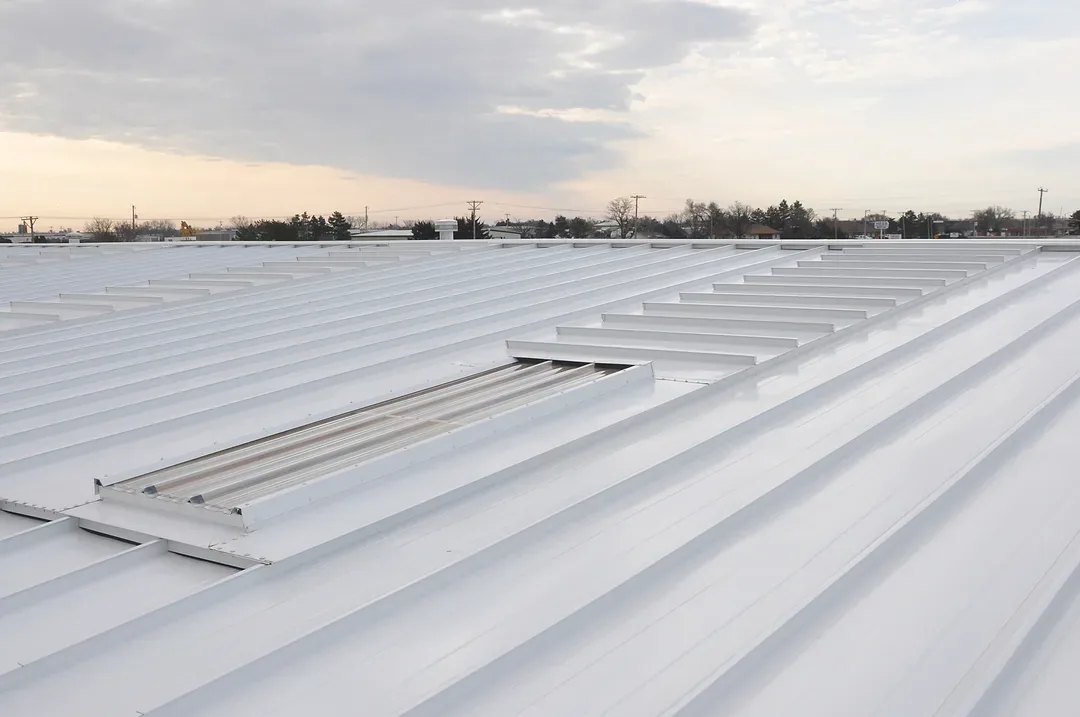
We check for seam separation, panel distortion, loose clips, fastener movement, corrosion, scratches, and openings around curbs or pipes. Oil canning, a visible waviness in sheet metal, may be cosmetic; it does not by itself prove a leak or structural failure. We compare the panel shape with the clip line, seam, and support. The observed condition and its location determine whether a detail needs repair or monitoring.
Interior staining can begin well below a roof opening. Water may travel along a purlin, insulation, or panel sidelap before becoming visible. We map the interior mark and inspect nearby eaves, ridges, valleys, curbs, and penetrations. Photos should show the surrounding panel field as well as the close detail so an owner can find the location later. If concealed layers affect the repair, we identify whether an opening or test is useful.
Clips let standing-seam panels lengthen and shorten as the metal warms and cools. Clips and seams must restrain the roof while allowing designed movement. A fixed point placed incorrectly or a clip that has shifted can stress a seam, distort a panel, or loosen fasteners at a transition. We inspect attachment spacing and direction against the system details and look for marks showing where movement has been restricted. A new sealant bead does not correct a clip or support problem.
Nearby Detroit winter normals include snow and cold, while July average highs are in the low 80s Fahrenheit. The station data are regional context, not a snow-load calculation for the building. We inspect for actual panel deformation, ice blockage, open seams, and flashing separation. Snow shedding can also affect entries and loading zones below, so the owner should consider where falling snow may land when defining access and work areas.
Standing-seam profiles differ in seam geometry, clip design, substrate, and how panels terminate at eaves and ridges. We identify the system using records and field details before ordering parts or forming repairs. A clip or seam tool designed for another profile may not engage the panel correctly. We check fasteners, purlins or deck support, underlayment, and the separation between metal and adjacent roof layers where accessible.
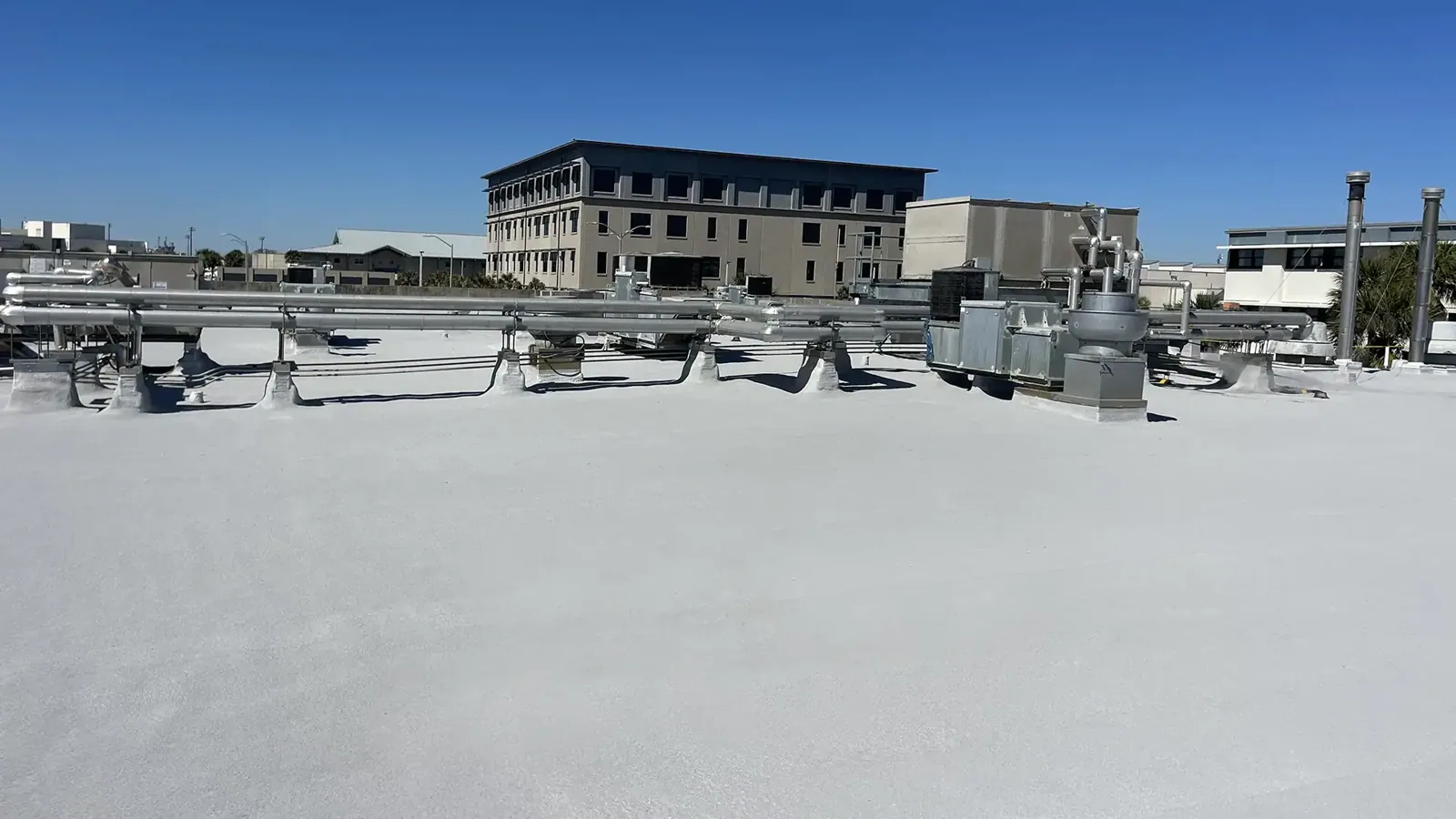
Penetrations need compatible curbs, flashing, and movement clearance. A pipe placed through a panel without a designed transition can become a recurring leak point. We inspect the flashing’s attachment to both panel and curb, plus drainage on the uphill side. If the roof is exposed-fastener metal rather than standing seam, a metal retrofit may be evaluated separately. A curb or support repair may also be part of the work.
At an eave, we check the drip edge, underlayment termination, gutter, and panel end detail. At the ridge, the cap and closures must suit the panel profile and exposure. Valleys and wall transitions need laps that move water outward rather than under the sheet. We inspect the fastener line and the metal’s condition where water concentrates. If a gutter backs up or a downspout connection is open, the drainage route may need work beyond the panel repair.
Sterling Innovation District and Velocity SmartZone are named commercial and business-development places in Sterling Heights. These local facts do not tell us whether a property has metal roofing or what profile it uses. For each roof, we record eaves, valleys, ridge details, and the outlet path on its own plan. That makes later repair visits faster to target and keeps a new metal scope from assuming a uniform building stock.
A repair may require resetting or replacing clips, correcting a seam, replacing a panel, or rebuilding a curb flashing. We confirm the metal gauge and finish where records allow and check for corrosion or substrate deterioration before closing the detail. Sealants and tapes are used only as part of a compatible system repair. A fastener driven through a moving panel can create another failure, so attachment changes must match the panel design.
For a larger project, we compare targeted work with panel replacement or an alternate roofing system. A metal roof can sometimes receive an engineered retrofit assembly, but the supporting structure, panel condition, and drainage must be evaluated first. We can coordinate related edge-metal repairs and drainage corrections. Each repair is inspected at the seam and surrounding transition before the work zone is released.
The report identifies panel type where known, seam and clip conditions, penetrations, corrosion, and the repair boundary. It notes whether the roof records matched field observations and what remained concealed. If panel distortion is cosmetic, that distinction should be stated with the inspected context. Where a structural question exists, we identify it for the appropriate professional rather than treating a roofing observation as a capacity determination.
The closeout identifies panel profile, clip condition, penetration transitions, corrosion, and limits of inspected areas. We compare field observations with product records and flag any concealed condition requiring follow-up. For a neighboring low-slope section, we can also review a TPO membrane against that assembly’s own records and inspection.
Not necessarily. Oil canning can be an appearance condition. We check the seam, clips, support, and water entry evidence before calling for repair.
The repair depends on panel geometry and how the penetration is flashed. We inspect whether the curb or pipe connection allows movement and drains correctly.
Yes. Clips and seams are designed to restrain the system while allowing thermal movement. We check whether attachment or a fixed point has restricted it.
Sometimes, if the profile, finish, access, and surrounding seams permit it. We inspect the adjacent panel connections before defining a single-panel scope.
Provide panel drawings, product information, installation records, and photographs of eaves, ridges, and seams. Those details help identify profile and compatible repair methods.
Share panel records, roof plans, photos, and leak locations. We will inspect clips, seams, penetrations, and perimeter drainage, then define a repair or retrofit scope that fits the system.