Home / Commercial Roofing Services / Rooftop Equipment Curb and Support Repair
Provide equipment identifiers, roof drawings, access rules, and interior leak locations. We will inspect the curb and support as connected details, document movement or moisture, and define the roofing work and trade coordination needed.
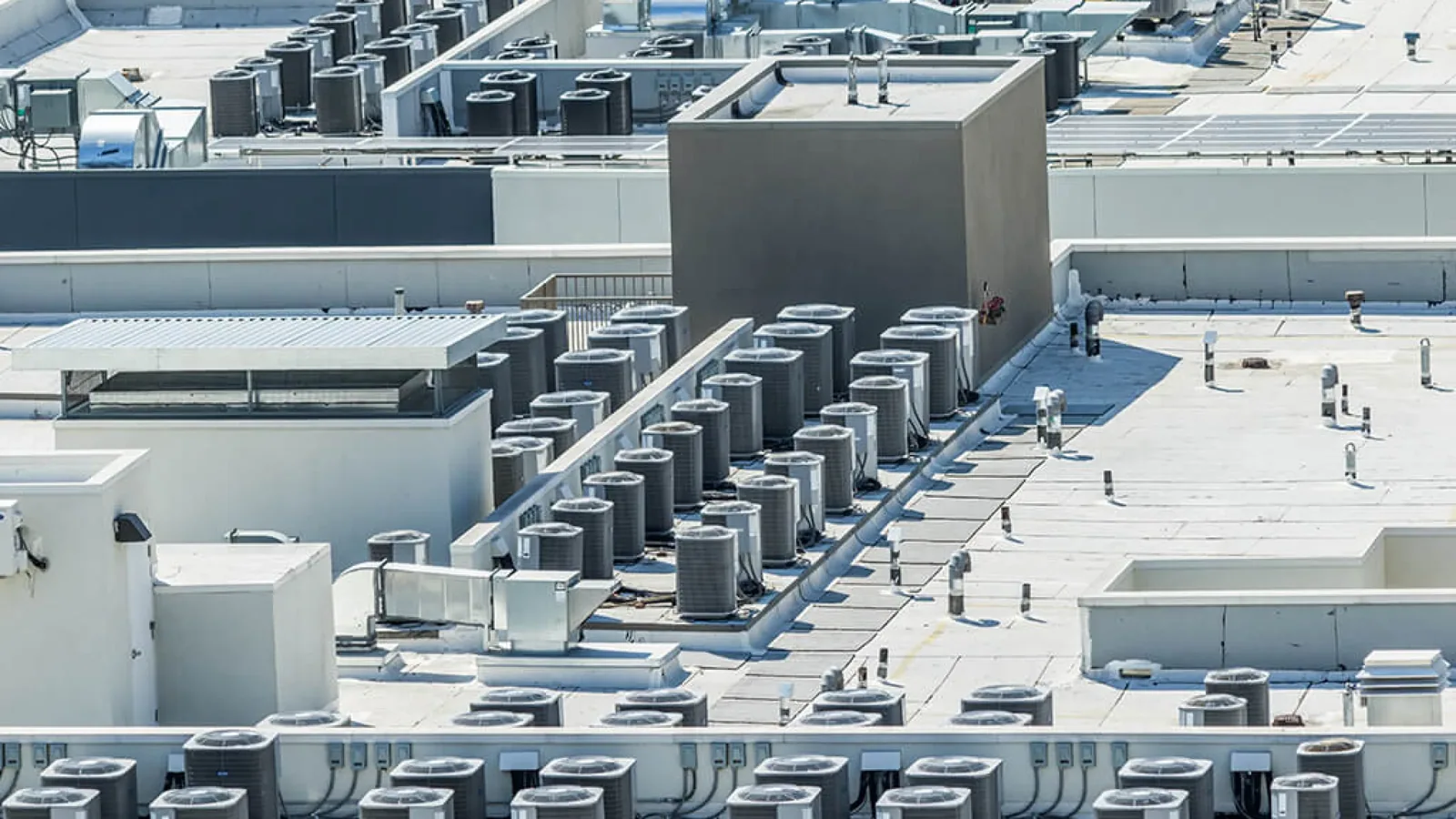
At a curb, we check the membrane turn, inside and outside corners, counterflashing, cap seams, and the curb-to-deck connection. A wrinkle can indicate movement or poor fit. A split at the corner may show that flashing was stretched too tightly or attached to an unstable surface. We note the height of the curb and whether water can stand against the detail. The inspection includes the roof surface above and below the unit because water can travel beneath the membrane before reaching the interior.
Pipe supports and equipment stands need a firm load path. We look for loose base plates, corroded fasteners, cracked sealant, shifted supports, and unsupported lines that move during operation. A roof patch cannot stop a pipe from flexing against the flashing. If the equipment support needs adjustment, we identify that work for coordination with the mechanical contractor. We then rebuild the roof detail around a stable point and verify that the membrane remains continuous.
Roof membrane moves with temperature. Equipment bases and pipe supports may expand, vibrate, or shift on a different schedule. The flashing has to bridge those movements without carrying the machine’s weight. If a support rests on membrane without the correct base or restraint, it can crush insulation and create a low spot. If a pipe clamp is loose, recurring movement can fatigue a boot or field flashing. We inspect both the roofing transition and the support connection before defining which trade owns each correction.
Nearby Detroit normals show a wide seasonal temperature range, from cold January averages to July highs in the low 80s. This regional climate context explains why materials and attachments move; it does not establish the condition of a particular Sterling Heights curb. We look for actual separation, distortion, or water entry. At the Mound Road industrial corridor, equipment-related roof work may intersect with active maintenance windows, but the access plan must be confirmed with each facility. No one should assume that an equipment repair can wait until a roofing crew happens to be present.
Before we reset a curb, we identify the membrane type, fastening method, insulation layers, and deck. A mechanically attached membrane may need a different flashing transition from an adhered system. The curb may sit on a wood nailer, metal frame, concrete upstand, or another support. We inspect that interface before installing new material. Fasteners must engage sound backing, and the repair must not leave an exposed path through the membrane or restrict required movement.
A rooftop unit can be replaced without changing its curb, but reuse depends on dimensions, condition, support, and compatibility with the new equipment. We document the curb opening and connection so the owner and mechanical contractor can compare them with the planned unit. If the curb is too low for the assembly or has deteriorated, replacement may be needed before flashing can be completed. We do not assume a new unit will fit a curb based on appearance alone.
We check the uphill side of each curb for ponding, a blocked path, or a cricket that stops short. A curb can act like a dam if the roof slopes toward it. The detail may need a small saddle, tapered insulation, or broader correction if the deck has settled. We verify the nearest drain and overflow route before deciding that flashing alone will solve the leak. A drainage review can be coordinated with drain and scupper repairs when water collects across the same roof area.
Nearby commercial areas include the Sterling Innovation District and North Van Dyke River District. Their land-use descriptions do not show how a particular roof supports HVAC or process equipment. We inspect the actual curb, deck transition, and drainage path at the property. For multi-building operators, location-specific photos and equipment identifiers help prevent a repair on one roof from being mistakenly carried onto another building’s scope.
We remove loose flashing and failed membrane to sound material, then prepare the curb or support interface. The repair may involve replacing a boot, rebuilding corner flashing, resetting a termination, replacing a curb cap, or restoring the membrane around the base. Each material must match the roof system and its preparation requirements. A surface bead can be part of a compatible detail, but it cannot take the place of secure attachment or sound flashing.
Equipment repairs can require escort, lockout, rooftop service clearance, or coordination with the facility’s mechanical staff. We confirm the building’s rules and who can authorize access before mobilization. The city’s large manufacturing and defense employers make industrial operations an important local building use, but their procedures differ. We ask for site-specific access instructions, equipment shutdown restrictions, and the interior areas that need protection.
Where an owner tracks multiple units, we can add curb condition, repair history, and follow-up needs to a roof condition report or an asset management record. That list should identify the building and unit, not just say “check curbs.” When deterioration extends beyond one penetration, we can inspect the larger roof area and compare repair with system-level options. The recommendation follows the assembly rather than the equipment label.
Sometimes. We confirm service clearances, roof access, and the scope with the facility contact and mechanical staff. The unit’s operating requirements determine whether a shutdown is needed.
The support must be stabilized before final flashing. We identify the movement and coordinate the mechanical correction so the roof detail is not asked to carry that load.
No. Water may arrive from an uphill seam, drain, or wall detail. We trace the path and compare it with the interior evidence before assigning the source.
Reuse depends on dimensions, curb condition, support, and the new unit’s requirements. We document those conditions for coordination before flashing is closed.
Provide roof access rules, unit identifiers, leak locations, roof records, and any shutdown limits. That lets us inspect the right detail and plan around facility operations.
Provide equipment identifiers, roof drawings, access rules, and interior leak locations. We will inspect the curb and support as connected details, document movement or moisture, and define the roofing work and trade coordination needed.