Home / Property Types We Roof / Big-Box Retail Roofing
Share the leak locations, roof plans, and store access window. We will inspect the relevant zones, document the confirmed water path, and recommend a repair boundary that can be safely closed in.
We start with the store’s report: stain location, first appearance, weather conditions, and whether the area is still taking water. We compare it with roof slopes, joists, deck direction, drains, and nearby curbs.
On the roof, we map seams, prior patches, equipment supports, and changes in membrane or insulation. A moisture scan or test cut is useful when it will determine the repair boundary. We record the reason for each test and close every approved opening the same day. A short event after thaw can leave a different pattern from a persistent leak around a curb.
Water can travel along a deck flute or beneath a membrane before it appears indoors. Low spots, blocked strainers, failed drain bowls, open laps, and curb corners are common places to test, but inspection decides which one matters. We check the primary drain and overflow path together. If water is held at a low point, it can press against a seam or flashing for longer than expected.
Nearby Detroit climate normals show seasonal snowfall and a large swing between winter and summer temperatures. Those are regional reference values, not a Sterling Heights roof-load reading or a measurement at an individual store. Snowmelt can run toward an outlet and refreeze when temperatures drop. Repeated movement can stress metal details and older sealant. We distinguish water entry from condensation or indoor moisture.
For confirmed outlet issues, we can coordinate drain and scupper repair with membrane work.
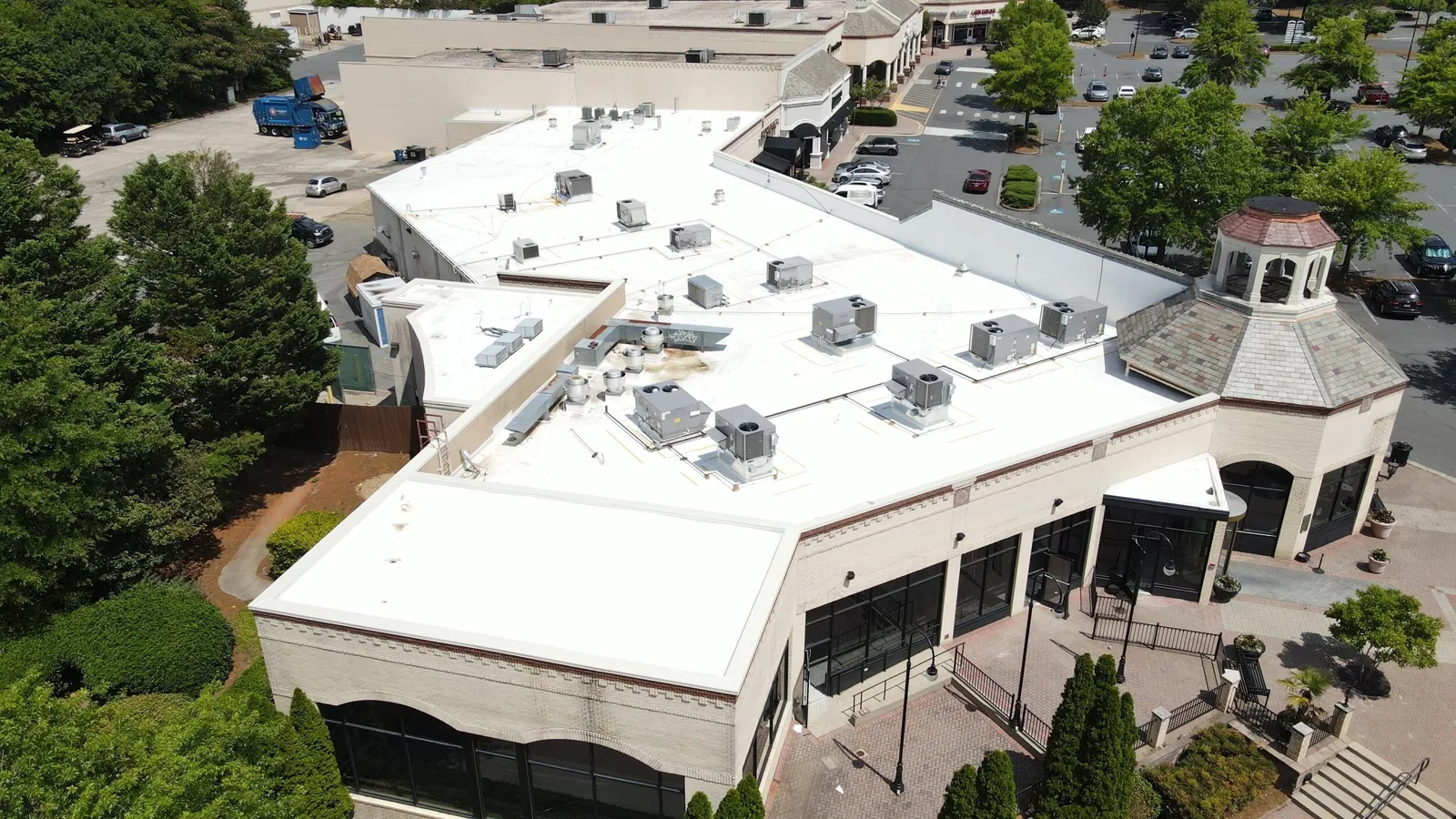
Big-box roofs often include large membrane fields, perimeter metal, rooftop equipment, skylights, and later additions. We identify membrane type, seam layout, insulation, deck, and repair history by zone. A patch needs a compatible surface and stable substrate. A test cut can confirm layer count and wet insulation before a recover is considered.
Equipment replacement can change curb height, support details, and flashing. We look for abandoned penetrations, loose fasteners, cut membrane, and metal that no longer bears evenly against the curb. Rooftop work by another trade is recorded as an interface condition, not treated as a proven cause.
Where different systems meet, thermal movement can concentrate at a transition. We inspect the membrane termination, cover board, fastener rows, and edge restraint. A repair that bridges incompatible materials may split again. The proper detail follows the verified assembly and manufacturer requirements for that product, not a generic coating over the visible seam. See roof recover planning when the question is whether an existing roof can remain in place.
We plan the work boundary with facilities and store management. Loading docks, customer entries, fire lanes, receiving hours, lift locations, and merchandise protection affect where materials can move. A roof repair should not block an active dock or leave an unprotected opening over an occupied area. The store identifies restricted routes; we keep each opened zone small enough to secure.
For a large repair, we divide the roof into areas with clear start, stop, and close-in points. The crew removes only the material needed to reach sound roofing, replaces wet insulation when confirmed, and closes the membrane before leaving the zone. If weather threatens or hidden damage extends the work, the affected section receives temporary protection and the owner gets a documented scope decision.
The city reports 100,000 daily vehicles on the Golden Corridor. That figure does not set a store’s loading route, so we confirm access with management. We confirm actual truck routes, staging permissions, and work hours with the site. The Sterling Heights Golden Corridor and the Lakeside City Center area have distinct commercial patterns; neither replaces property-specific access approval.
Big-box roofs can have long parapets, storefront canopies, loading-side edges, and many rooftop curbs. We inspect coping joints, fascia, gutters, scuppers, downspouts, and membrane termination near the reported area. A loose coping splice can admit water behind the wall assembly. A blocked gutter can discharge back toward a fascia.
At a curb, the flashing height and termination matter as much as the membrane surface. We check corners, counterflashing, pitch pans, and support penetrations for movement or open sealant. If the equipment pad or curb has shifted, a surface patch will not correct that movement. The report identifies roofing, sheet-metal, or mechanical coordination needs.
On a low-slope roof, overflow locations need to remain clear. We note debris, damaged strainers, discharge staining, and any condition that could redirect water toward an entrance or wall. For a confirmed perimeter defect, our edge metal and coping service can be scoped alongside the main roof repair. Separate line items help the manager distinguish immediate leak control from planned renewal.
We remove failed membrane and wet materials only to a sound boundary. The replacement insulation, cover board, membrane, and flashing must suit the existing system and attachment. Seams are prepared and completed according to the assembly requirements. At a drain, the repair connects to the bowl and surrounding field. At a curb, it terminates at a stable, compatible detail. If inspection finds several failures, the scope lists them separately instead of spreading coating across every visible patch.
Temporary protection can stop active water while the owner decides on permanent work; we document what remains open for verification. Emergency response does not prove that a full replacement is needed. Conversely, a small surface patch is not enough where wet insulation or a deteriorated deck extends beyond it. Test results define that boundary.
When an owner is comparing repair with replacement, a condition report can show the roof’s zones, repeat leak locations, prior work, and test findings. The report supports planning; required design or engineering review remains separate. Our roof condition reports give the facilities team a usable record for budgeting and sequencing.
The final record names the area inspected, observed assembly, moisture findings, repair limits, access constraints, and any item that needs another trade. Photos should show both the detail and its position on the roof.
Send roof plans, leak locations, equipment replacement records, prior patch notes, and the receiving schedule. We will identify the first roof zone to inspect and the site contact who can confirm access. If a large store has several reports, provide each interior location separately. Where recurring leaks exist, a roof program for multiple properties can keep inspection records consistent across the portfolio.
The next action depends on what the roof shows. It may be a localized repair, drain correction, curb flashing, moisture test, or phased replacement plan. We state what is confirmed and what remains uncertain, then close each approved work area against weather before moving to the next.
Usually, if access and weather allow. We phase the work into secure zones and coordinate customer routes, docks, and close-in limits with store management.
Water can travel below the membrane or along the deck before reaching a ceiling. We compare the interior report with roof slope, seams, curbs, and drains.
No. We identify the installed assembly and test the suspected failure first. A coating is suitable only when the system and substrate support it.
Provide roof plans, leak locations, prior repairs, equipment records, and site access rules. Separate reports by interior area if several zones are involved.
No. Nearby Detroit climate normals are regional context. Roof condition, drainage, assembly, and site-specific findings set the repair scope.
Share the leak locations, roof plans, and store access window. We will inspect the relevant zones, document the confirmed water path, and recommend a repair boundary that can be safely closed in.